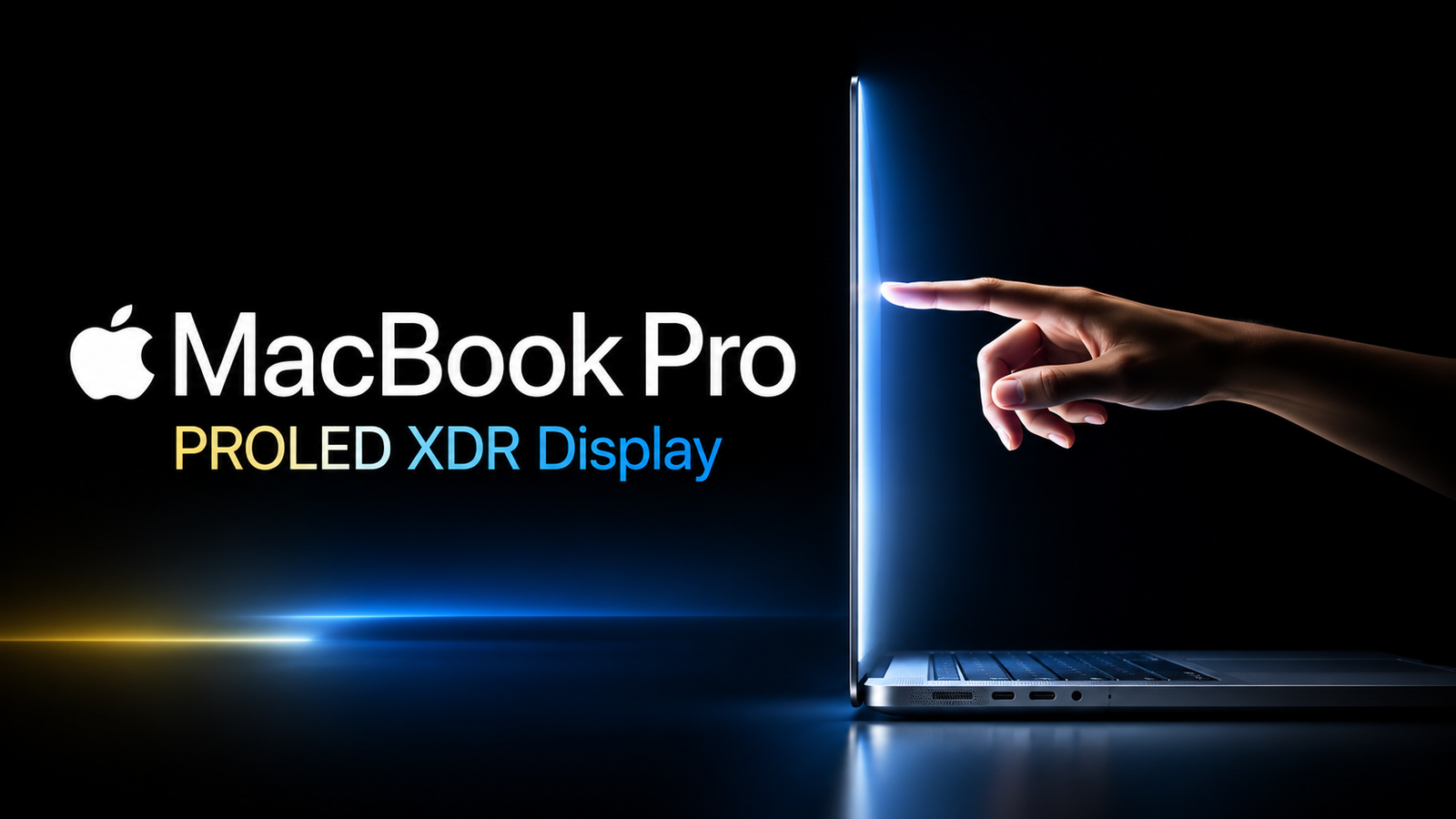
Apple has introduced its first touchscreen MacBook Pro, marking a major shift in the company’s long-standing approach to laptop design. The launch brings touch functionality to the MacBook for the first time, allowing users to interact directly with the display through taps, swipes, pinches and drag gestures.
Unveiled on October 28, the new MacBook Pro features a PROLED XDR display based on tandem OLED technology. It is powered by Apple’s M5 Pro or M5 Max chips and offers up to 128GB of unified memory and 16TB of storage.
To introduce the technology, Apple has released a one-minute-and-50-second advertisement that places the new display at the centre of its storytelling. Staying with the brand’s minimalist visual approach, the film uses cinematic close-ups and voice-over narration to demonstrate the screen’s capabilities, including anti-glare technology, reflection protection and real-time pixel correction.
Opening with the line, “If you give a Mac an OLED, it’ll have to be a different kind of OLED”, the film moves through demonstrations of touch interactions, showing how users can manipulate content directly on the display. It concludes with the phrase “it all clicks”, bringing the product’s new functionality together through a simple creative message.
The launch is particularly notable given Apple’s historical resistance to touchscreen laptops. In 2010, co-founder Steve Jobs described the concept as “ergonomically terrible”, arguing that repeatedly raising one’s arm to operate a vertical screen could cause fatigue. The company’s position reflected its preference for keeping touch-based interaction on devices such as the iPad, while MacBooks remained centred around keyboards and trackpads.
That distinction has now evolved. Rather than replacing traditional controls, the new MacBook Pro adds touchscreen functionality as another way to navigate and work with content. This allows users to retain familiar inputs while accessing direct screen interaction when needed.
Apple’s earlier stance on device convergence was also evident in 2012, when CEO Tim Cook questioned the idea of combining laptops and tablets. “Anything can be forced to converge,” Cook said, comparing the concept to combining a toaster and a refrigerator.
Meanwhile, competitors had already been exploring touchscreen computing. Microsoft’s Windows 8 introduced a touch-oriented interface in 2012, while its Surface Pro range helped popularise hybrid devices combining tablet portability with laptop functionality. Other PC manufacturers subsequently expanded their touchscreen and convertible laptop offerings.
Apple, however, continued to maintain separate product experiences for the MacBook and iPad. Its latest launch represents a shift towards incorporating elements of hybrid computing without abandoning the MacBook’s established design approach.
From an industry perspective, the move signals how established product philosophies can adapt to changing user expectations and competitive pressures. Apple’s decision to introduce touch functionality without replacing the keyboard or trackpad suggests a more flexible approach to personal computing. The accompanying film reinforces this shift by making the technology itself the central creative proposition, turning a long-awaited product change into the focus of the launch narrative.